

A standard gorilla trek gives you one hour with a gorilla family, and for many people that hour passes in what feels like minutes. The 4 hour gorilla habituation experience exists for travellers who want more. It extends the encounter fourfold and places you alongside the trackers and researchers who spend years helping wild gorillas become comfortable with human presence.
This guide explains what the experience is, how the four hours work, where it takes place, what it costs, how to book it and how to prepare. Because permit prices in Uganda have been under review, it also explains how to verify current tariffs before you commit.
What Is the Gorilla Habituation Experience?
Habituation is the slow process of teaching wild gorillas to tolerate human observers without fear or aggression. Teams of trackers and researchers visit the same gorilla group daily, behaving calmly, keeping a respectful distance and gradually reducing the animals’ stress. The process typically takes around two years, after which a family is considered habituated and may be opened to standard tourist treks.
The habituation experience lets a small number of visitors join this process during its later stages. Instead of the usual one hour, you may spend up to four hours with a semi-habituated family, observing behaviour, learning from the experts and contributing indirectly through permit revenue that funds the programme.
It is a rare option. As far as most operators are aware, it is available only in Uganda, and only in one part of the country.
Where Does It Take Place?
The experience is offered in the Rushaga sector of Bwindi Impenetrable National Park, in the southwest of Uganda. Rushaga has the largest number of gorilla families of any Bwindi sector, and it hosts the families undergoing habituation. Operators report that one or two groups are normally in the programme at any given time, and the specific families can change as habituation is completed or new groups are selected, so confirm the current group with your operator.
Bwindi is a dense, steep rainforest, and Rushaga lies in the south, which makes it convenient for travellers arriving from Rwanda. The drive from Kigali to the southern sectors generally takes several hours, depending on the border crossing, which is much shorter than the journey from Entebbe.
How the Four Hours Work
The four-hour period is the key difference from a standard permit. Operators usually explain that the clock starts once you reach the gorillas, and the hours are counted from the moment the group is found, not from the start of your hike. The time to reach the family can range from under an hour to several hours depending on where the gorillas moved overnight, so the whole day can be long.
Early start. You gather at the Rushaga headquarters in the morning for registration and a briefing on rules and expectations.
The hike. Trackers lead the way, following the previous day’s trail. You walk through steep, muddy and often dense forest. Fitness matters, and many visitors hire porters.
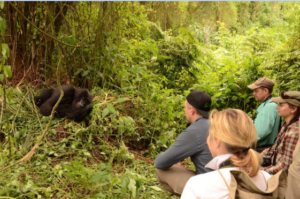
Time with the family. When you arrive, you join the researchers and trackers. Because the gorillas are still adapting to humans, they may move more than a fully habituated family, so you follow quietly at the pace of the group. You see feeding, resting, grooming, play and social interaction, and you can ask your guides about the family’s dynamics and the habituation process.
The longer view. Over four hours, you witness more than an isolated moment. You may see a silverback assert authority, a juvenile test boundaries or an infant learn to forage, and you see how the gorillas react as the group settles.
The return. After your allotted time, you hike back, usually tired but deeply satisfied.
How It Differs from a Standard Trek
| Feature | Standard trek | 4 hour habituation experience |
| Time with gorillas | 1 hour | Up to 4 hours |
| Group size | Up to 8 visitors | Up to 4 visitors |
| Gorilla status | Fully habituated | Semi-habituated |
| Location | Several sectors and countries | Rushaga sector, Uganda |
| Cost | Lower | Significantly higher |
| Role | Observer | Observer alongside researchers |
| Physical demand | Moderate to high | Moderate to high, with longer time in the forest |
The smaller group size and longer duration combine to produce a calmer, more intimate experience. Many visitors say it feels closer to field research than to tourism.
Cost: Verify Before You Book
The price has been a moving target, so treat any single figure with care.
Under the Uganda Wildlife Authority’s July 2024 to June 2026 tariff, the habituation permit was widely reported at $1,500 per person for foreign non-residents, with a lower price for foreign residents. Several operators have also reported that an updated tariff increases the permit to $1,800 for foreign non-residents, with an effective date given as 1 January 2027 by some sources and as July 2026 by others. Some also report adjustments for foreign residents, other African visitors and East African citizens.
Because sources disagree on timing, the safest approach is this:
- Ask your operator which tariff applies to your exact trek date.
- Request written confirmation that the permit has been issued at that price.
- Check the Uganda Wildlife Authority’s published tariff or its customer service for the latest figures.
Beyond the permit, budget for:
- Accommodation near Rushaga, from mid-range lodges to luxury camps
- Transport by road or domestic flight
- Porters, whose services are inexpensive and support local families
- Meals, drinks and tips
- Insurance, visas and international flights
The permit usually covers entry, rangers, guides and researchers’ services, but not lodging or transport. Always ask what is included.
Booking Tips
Because the experience is limited, planning ahead is essential.
- Book very early. Only a small number of habituation permits are issued each day, and operators commonly recommend booking many months in advance. For peak periods, a year or more is not unusual.
- Use a reputable operator. Make sure your permit is confirmed with the authority before paying in full, and understand cancellation, rescheduling and refund policies.
- Be flexible. Shoulder months can be easier to secure.
- Confirm the group. Ask which family you are likely to join, and be aware that allocation can change.
- Plan buffer days. Weather, flight delays or border crossings can complicate tight schedules.
Getting There
Rushaga is in southern Bwindi. Several routes are possible:
- By road from Kigali, Rwanda: The most popular option for travellers combining Rwanda and Uganda, with a transfer of several hours that includes border formalities. Check visa requirements, including any East African Tourist Visa options.
- By road from Entebbe or Kampala: A long drive of about a full day, often broken by a stop in Queen Elizabeth National Park.
- By air: Domestic flights to airstrips near Bwindi, followed by a road transfer, save time at a higher cost.
Many travellers pair the habituation experience with a standard trek, a visit to Rwanda’s gorillas or a chimpanzee trek in Kibale.
Physical Demands and Fitness
Four hours with gorillas does not mean four hours of sitting. You will walk through steep, uneven and often wet terrain at altitude, you may follow the group as it moves and you will hike back at the end. Total time in the forest can reach eight hours or more on some days.
To prepare:
- Build stamina with hill walking, stair climbing and long hikes in the weeks before travel.
- Break in your hiking boots well in advance.
- Train with a loaded daypack.
- Hire a porter, because they carry your bag and assist on steep sections.
If you have mobility concerns, discuss them with your operator in advance and consider a standard trek instead.
What to Pack
- Sturdy, broken-in hiking boots with good grip
- Long trousers and a long-sleeved shirt in muted colours
- Lightweight waterproof jacket
- Gardening gloves
- Hat, sunscreen and insect repellent
- Daypack with water, a packed lunch and snacks
- Camera with strong low-light performance, spare batteries and a rain cover (no flash)
- A small towel or spare shirt for the return
Since the day can be long, carry enough food and water for several hours in the forest.
Rules and Etiquette
Rules are strict because the gorillas are still adapting.
- The minimum age is generally 15.
- Do not join the trek if you are ill. Gorillas are vulnerable to human diseases, and rangers may refuse entry.
- Keep your voice low and follow your guide’s instructions exactly.
- Maintain the distance advised, and stay calm if the gorillas approach.
- Do not eat, drink or smoke near the animals.
- No flash photography.
- Take all litter with you.
These measures protect the gorillas and the success of the habituation programme.
Is the 4 Hour Experience Worth It?
It is a strong choice if:
- You want a long, immersive encounter rather than a short visit.
- You are a photographer or wildlife enthusiast who needs time to observe behaviour.
- You value learning from researchers and trackers.
- You are comfortable with a demanding day.
A standard trek may suit you better if:
- You prefer a shorter, less strenuous outing.
- Your budget is tight.
- Your schedule makes early booking difficult.
For many travellers, a smart compromise is to do one standard trek and one habituation experience, giving both a comparison and a deeper encounter.
Conclusion
The 4 hour gorilla habituation experience offers a rare chance to spend a meaningful stretch of time with mountain gorillas, in a small group and alongside the people who make gorilla tourism possible. It is more expensive and more demanding than a standard trek, and it needs early booking and careful price verification because tariffs have been changing. For travellers who want depth rather than speed, it is among the most rewarding wildlife experiences in Africa. Confirm the current permit price, book as early as possible, prepare physically, and approach the forest with patience and respect. Four hours is long enough to see gorillas as individuals rather than as a sighting.
Key Takeaways
- The habituation experience offers up to four hours with a semi-habituated gorilla family, compared with one hour on a standard trek.
- It is available only in the Rushaga sector of Bwindi Impenetrable National Park, Uganda.
- Groups are limited to four visitors, and the minimum age is typically 15.
- The permit was widely reported at $1,500 under the 2024 to June 2026 tariff, with reports of an increase to $1,800 for foreign non-residents under an updated tariff. Always confirm the price for your travel date.
- Permits are very limited, so book many months ahead.
- The day can be long and physically demanding, so prepare with fitness training and a porter.
- Strict health and behaviour rules protect the gorillas.
Frequently Asked Questions
- What is a 4 hour gorilla habituation experience?
It is a Uganda-only activity that lets a small group spend up to four hours with a semi-habituated gorilla family, working alongside trackers and researchers. - Where is it available?
Only in the Rushaga sector of Bwindi Impenetrable National Park. - How much does it cost?
The permit was reported at $1,500 for foreign non-residents under the 2024 to June 2026 tariff, with reports of an increase to $1,800 under an updated tariff. Confirm current prices with the Uganda Wildlife Authority or your operator. - How many people can join?
A maximum of four visitors per group. - When does the four hours begin?
Operators generally count the time from when you reach the gorillas, not from the start of the hike, but confirm the exact arrangement with your operator. - Is it physically demanding?
Yes. The terrain is steep and muddy, the hike can be long and you may follow the gorillas as they move. Good fitness helps. - What is the minimum age?
Generally 15 years. - How far ahead should I book?
As early as possible, often many months ahead, and longer for peak periods. - Can I combine it with other activities?
Yes. Common additions include a standard gorilla trek, Rwanda’s Volcanoes National Park, chimpanzee tracking in Kibale and a savannah safari in Queen Elizabeth National Park. - What if I fall ill before the trek?
Tell your operator and guides immediately. You may be refused entry to protect the gorillas, so check refund and rescheduling terms and consider insurance that covers permit costs.